
Anxiety Treatment & CBT in Newcastle and Lake Macquarie
Anxiety can be useful, but it can become restrictive when worry, panic, avoidance or reassurance seeking begins to interfere with everyday life. The CBT Clinic provides evidence-based psychological treatment for anxiety at our Warners Bay practice, supporting clients across Newcastle and Lake Macquarie, with telehealth appointments available throughout Australia. This guide explains how anxiety develops, what can keep it going and how Cognitive Behaviour Therapy can help.

01. What is anxiety?
Anxiety is a normal human response to perceived threat, uncertainty or danger. It is your brain and body's way of preparing you to deal with something that might go wrong.
When you become anxious, your nervous system can shift into a state of heightened alertness. Your heart may beat faster, your muscles may tense, your breathing may change and your attention may become focused on potential threats.
These responses can be useful. Anxiety can motivate you to prepare for an important meeting, study for an exam, avoid genuine danger or think carefully about a difficult decision.
The problem is not anxiety itself. The problem occurs when anxiety becomes excessive, persistent or disproportionate to the situation, or when attempts to control anxiety begin to interfere with your life.
This is one reason anxiety can become self-perpetuating. The more threatening a situation feels, the more strongly your body responds. The stronger the physical sensations become, the more threatening they may seem.
02. When does Anxiety become a problem?
Feeling anxious from time to time does not necessarily mean that you have an anxiety disorder.
Anxiety becomes more concerning when it is:
occurring frequently or persistently
significantly stronger than the situation warrants
difficult to control
causing significant physical symptoms
leading you to avoid people, places or situations
interfering with work, study or relationships
affecting sleep or concentration
causing you to spend large amounts of time worrying or seeking reassurance
restricting the things you do because you are afraid of what might happen.
A useful question is not simply “Am I anxious?”, but:
“Is anxiety stopping me from living the life I want to live?”
03. What does Anxiety feel like?
Anxiety can affect your body, thoughts, emotions and behaviour.
Physical symptoms
Anxiety may cause:
racing or pounding heart
shortness of breath
dizziness or light-headedness
sweating
trembling
muscle tension
nausea or stomach discomfort
headaches
feeling restless or unable to relax
difficulty sleeping
feeling hot or flushed.
Thoughts
Anxious thinking commonly involves:
“What if something goes wrong?”
“What if I can't cope?”
“What if they judge me?”
“What if I lose control?”
“What if something is wrong with me?”
People experiencing anxiety may also find themselves repeatedly analysing situations, predicting negative outcomes, checking for signs of danger or seeking reassurance.
Behaviour
Anxiety can influence what you do.
You might:
avoid situations
leave situations early
procrastinate
repeatedly check things
seek reassurance
distract yourself
monitor your body
prepare excessively
use alcohol or other substances to manage discomfort
rely on particular people or objects to feel safe.
These behaviours often provide short-term relief, but they can unintentionally keep anxiety going in the longer term.
04. Why does Anxiety happen?
Why do I feel anxious?
Anxiety usually develops through an interaction between biological, psychological and environmental factors.
Some people may be more biologically or temperamentally prone to anxiety. Life experiences, stress, trauma, learning experiences and patterns of thinking can also influence how anxiety develops.
From a CBT perspective, however, an important question is:
What is maintaining the anxiety now?
For example, imagine someone becomes anxious about driving on the motorway.
They might think:
“I'm going to lose control.”
Their body responds with anxiety. They then avoid the motorway or only drive when someone else is present.
Avoiding the motorway reduces anxiety in the short term.
But the brain may learn:
“The motorway really is dangerous, and avoiding it kept me safe.”
The next time they consider driving, anxiety returns.
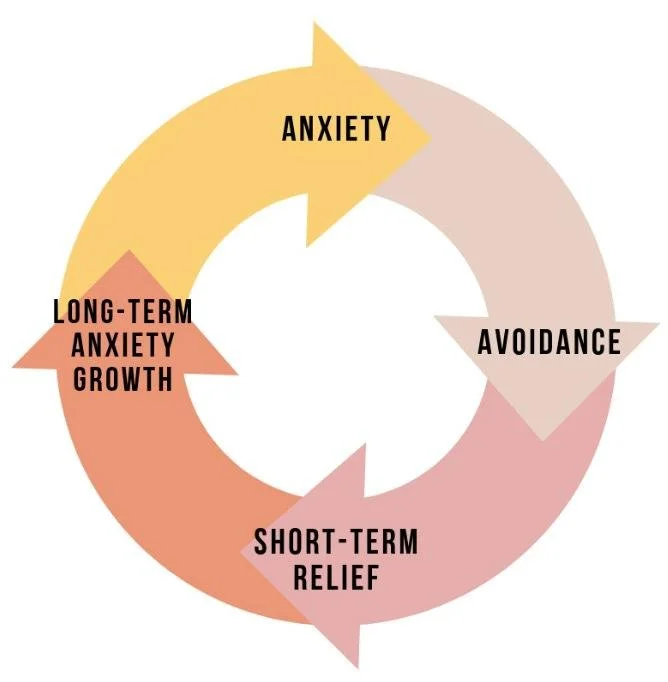
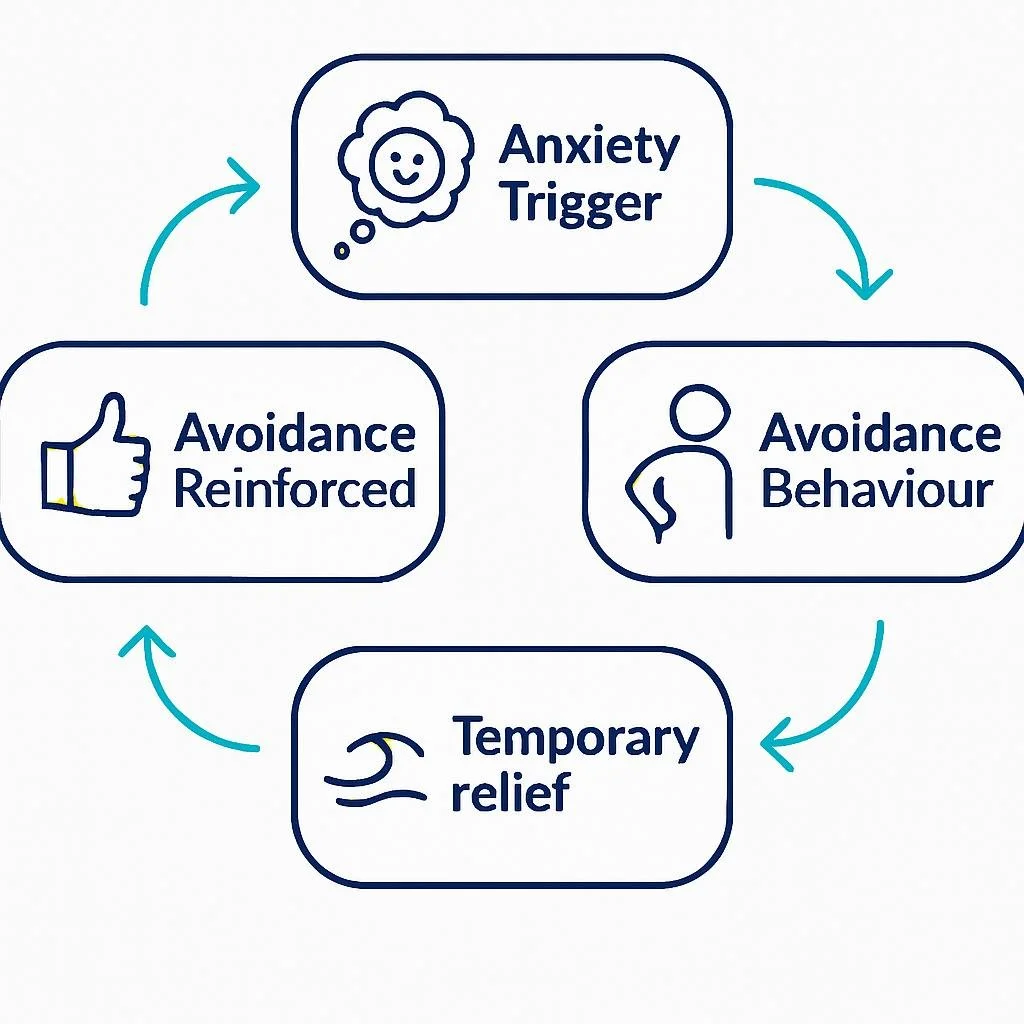
This creates a cycle:
Threat → Anxiety → Avoidance → Short-term relief → Anxiety maintained
This cycle is central to understanding CBT for anxiety.
05. How CBT understands anxiety
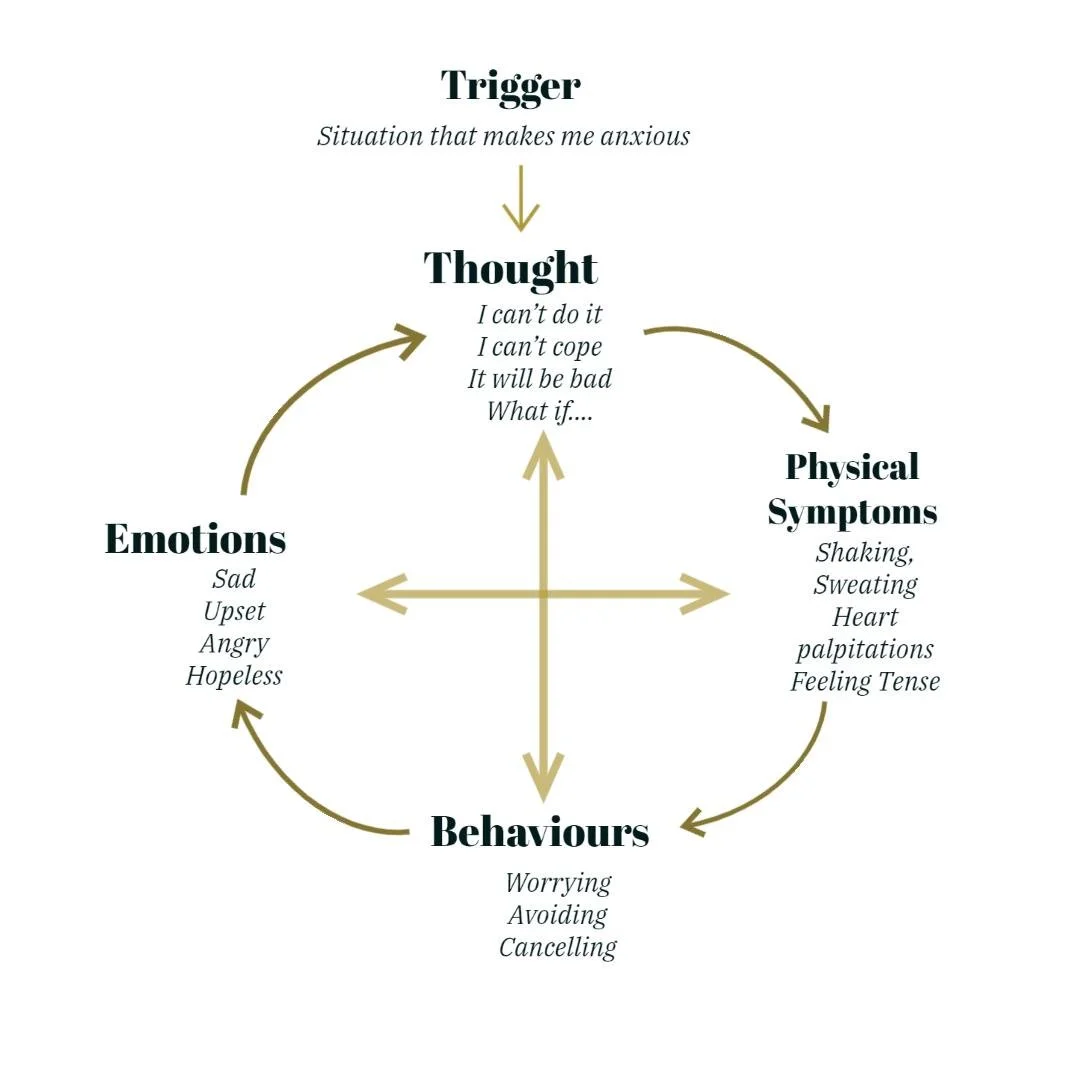
CBT proposes that anxiety is influenced by the interaction between:
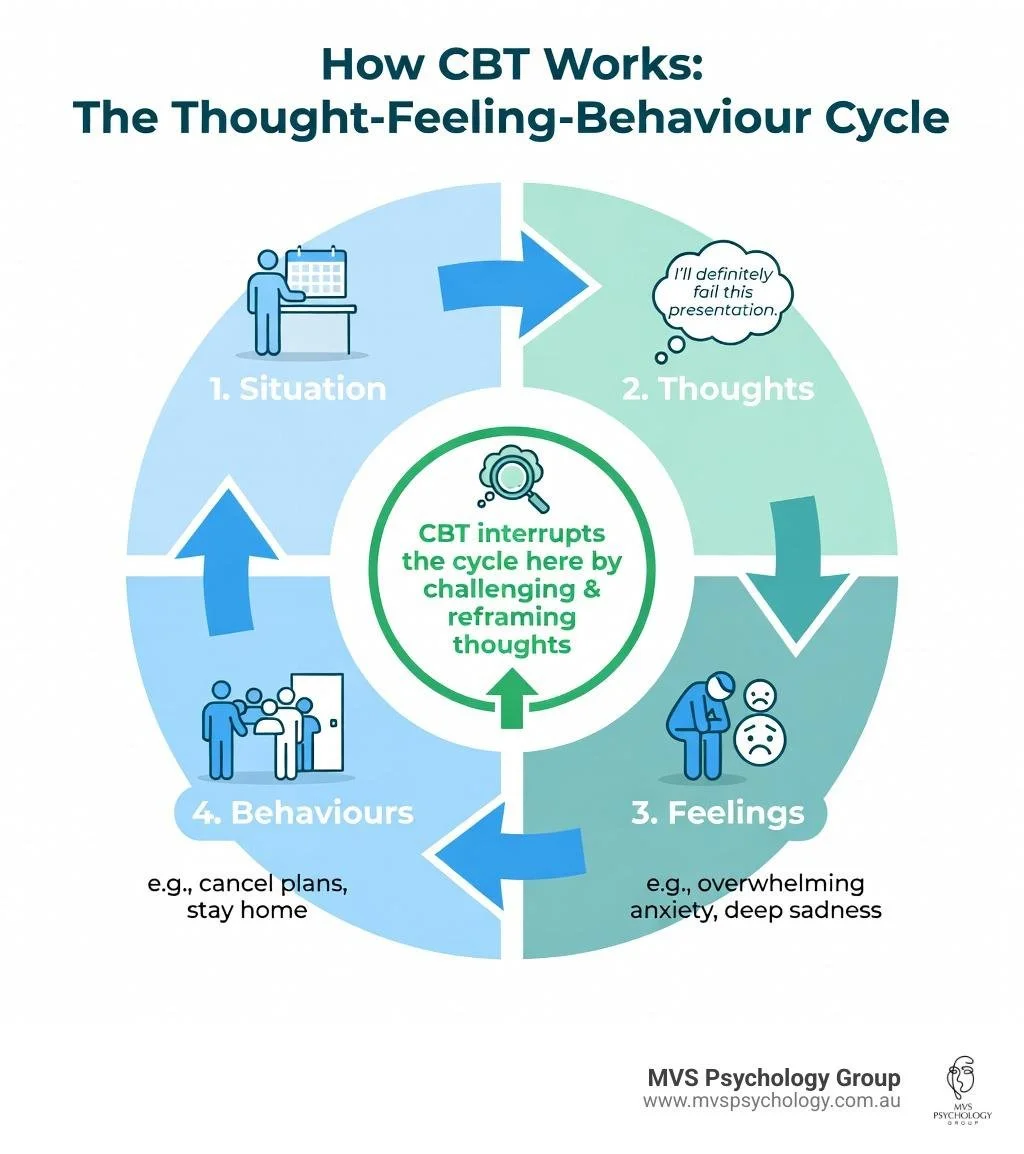
Situations → Thoughts → Feelings & physical sensations → Behaviours
Consider someone who receives an unexpected email from their manager.
Situation:
An unexpected email from your manager.
Thought:
“I've done something wrong. I'm going to get into trouble.”
Physical sensations:
Heart racing, tight chest, tension.
Emotion:
Anxiety.
Behaviour:
Avoid opening the email or repeatedly checking it.
The behaviour may reduce anxiety temporarily, but it prevents the person from discovering whether their prediction was actually accurate.
CBT therefore focuses not only on reducing anxiety, but on changing the patterns that maintain it.
06. The different types of Anxiety
Generalised Anxiety Disorder
Persistent and excessive worry across multiple areas of life.
Panic Disorder
Repeated panic attacks accompanied by persistent concern about having further attacks or significant changes in behaviour because of them.
Learn more about what happens during a panic attack and how CBT can help.
Social Anxiety Disorder
Marked fear of social or performance situations because of concerns about embarrassment, rejection, criticism or negative evaluation.
Specific Phobias
Intense fear of particular objects or situations, such as:
spiders
needles
heights
flying
animals
enclosed spaces.
Health Anxiety
Persistent concern about having or developing a serious illness, often accompanied by body checking, reassurance seeking or repeated health-related research.
Obsessive-Compulsive Disorder
OCD involves unwanted intrusive thoughts, images or urges (obsessions) and repetitive behaviours or mental acts (compulsions) performed in response to them.
Post-Traumatic Stress Disorder
PTSD can develop following exposure to traumatic events and may involve intrusive memories, avoidance, heightened arousal and changes in mood and cognition.
07. Why does Anxiety keep on coming back?
Why doesn't anxiety simply go away?
One of the most important concepts in CBT is that the things we do to reduce anxiety can sometimes unintentionally maintain it.
Avoidance is a good example.
Imagine someone is afraid of having a panic attack in a crowded shopping centre.
They begin avoiding shopping centres.
They feel less anxious.
That relief reinforces the avoidance.
Over time, however, their brain never gets the opportunity to learn:
“I can experience anxiety without anything terrible happening.”
The feared situation therefore continues to feel dangerous.
Other behaviours can have a similar effect, including:
reassurance seeking
checking
escaping
distraction
excessive preparation
constantly monitoring physical sensations
researching feared outcomes.
These strategies are understandable. They are attempts to feel safe.
But when they become the way you manage anxiety, they can prevent anxiety from naturally reducing and prevent new learning from occurring.
Avoidance can become a powerful cycle because immediate relief reinforces the urge to avoid again. Learn more about why avoidance makes anxiety worse and how to reduce it
Looking for help with Anxiety?
The CBT Clinic offers in-person appointments in Warners Bay and telehealth appointments throughout Australia.
08. CBT For Anxiety
How does CBT treat anxiety?
Cognitive Behaviour Therapy (CBT) is one of the most extensively researched psychological treatments for anxiety.
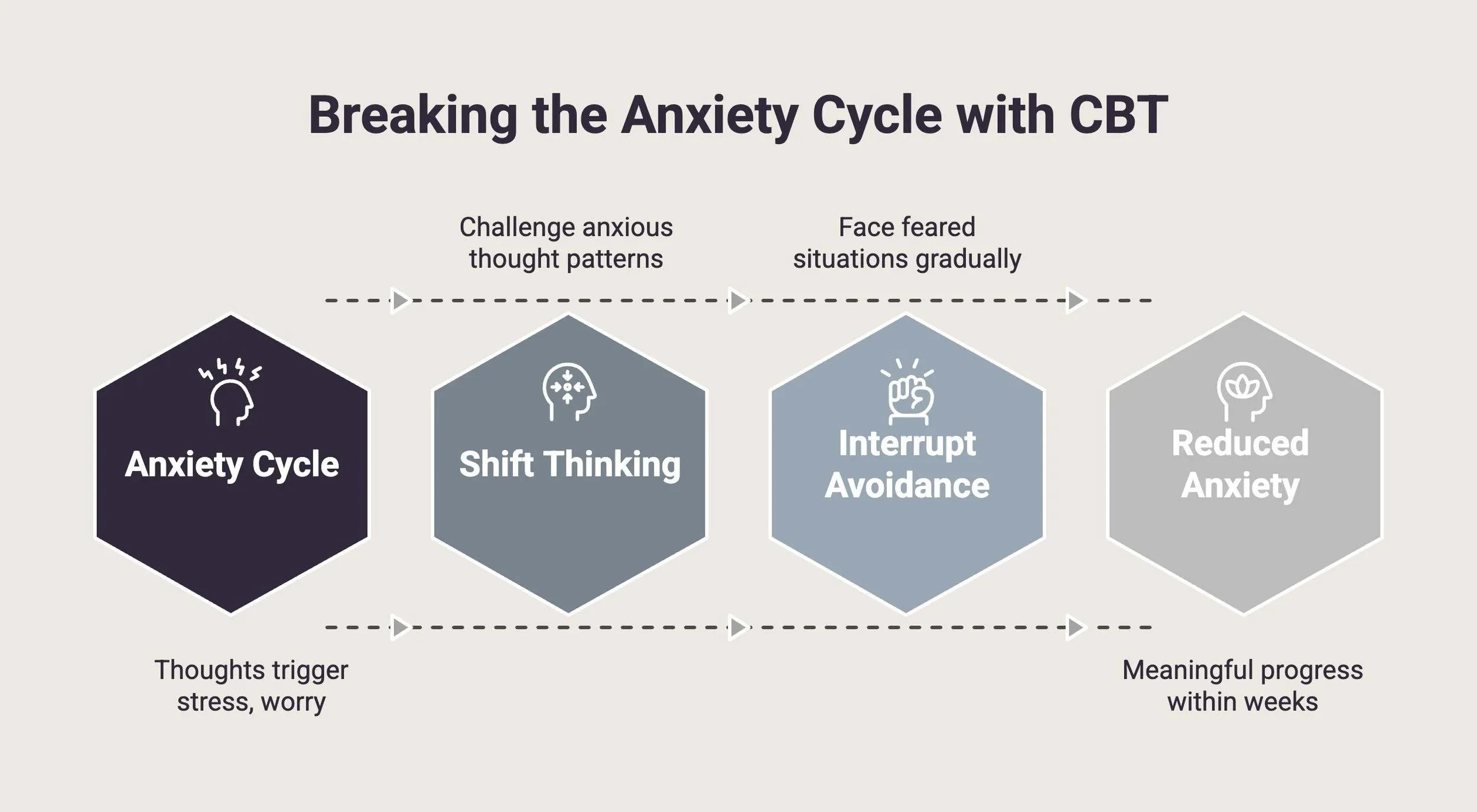
Rather than simply trying to make anxiety disappear, CBT aims to help you understand what is causing and maintaining your anxiety, and develop more effective ways of responding to it.
Depending on the type of anxiety you are experiencing, treatment may involve:
identifying unhelpful patterns of thinking
testing anxious predictions
reducing avoidance
reducing reassurance seeking and other safety behaviours
behavioural experiments
exposure therapy
interoceptive exposure for panic
problem-solving
developing more flexible responses to uncertainty
learning strategies for managing worry
relapse-prevention planning.
The specific treatment is tailored to the problem.
There is no single CBT technique that is appropriate for every form of anxiety.
09. Exposure Therapy
What is exposure therapy?
Exposure involves deliberately approaching feared situations, sensations, thoughts or memories rather than continually avoiding them.
The aim is not simply to force yourself to endure anxiety.
Instead, exposure provides an opportunity for new learning.
For example, someone with a fear of public speaking might gradually practise speaking in situations that produce increasing levels of anxiety.
Someone with panic disorder might learn to experience physical sensations associated with panic without immediately trying to escape or neutralise them.
Someone with contamination fears might gradually reduce compulsive washing.
Over repeated practice, people can learn:
anxiety is tolerable
feared outcomes are often less likely than predicted
anxiety can rise and fall without needing to be controlled
they can cope even when anxiety is present.
Importantly, exposure is generally planned collaboratively and tailored to the individual rather than being a case of simply "facing your fears."

10. How long does CBT for Anxiety take?
There is no fixed number of sessions that is appropriate for everyone.
Treatment length depends on factors including:
the type of anxiety
how long the problem has been present
the severity of symptoms
the number of problems being treated
how much avoidance is occurring
previous treatment
progress between sessions.
CBT is generally structured and goal-oriented. Rather than continuing indefinitely without a clear direction, treatment typically involves identifying specific goals, learning relevant skills and applying them between sessions.

11. What happens in a CBT Session?
What happens when you see a psychologist for anxiety?
Your first appointment will generally involve discussing what has been happening, how anxiety is affecting your life and what you would like to change.
Your psychologist may ask about:
when the anxiety started
situations that trigger it
thoughts and predictions
physical symptoms
avoidance and safety behaviours
its impact on work, relationships and everyday life
previous treatment.
You will then work together to develop an understanding of the problem and determine whether CBT is an appropriate treatment.
Subsequent sessions are generally structured around applying the treatment to the specific patterns maintaining your anxiety.
CBT is also practical. Depending on the problem, you may have exercises or behavioural experiments to complete between appointments.

12. What Can I do about Anxiety myself?
What can I do if I'm feeling anxious?
Some general strategies can help, although they are not a substitute for professional treatment when anxiety is significantly affecting your life.
Notice the prediction
Ask yourself:
“What am I predicting will happen?”
Anxiety often becomes less confusing when the feared outcome is made explicit.
Notice what you are doing to feel safe
Ask:
“What am I doing to prevent the feared outcome or reduce my anxiety?”
This might include avoiding, checking, seeking reassurance or escaping.
Gradually approach rather than avoid
Avoidance often provides immediate relief but can strengthen anxiety over time. Gradual, planned exposure can help break this cycle.
Accept uncertainty
Trying to achieve 100% certainty about an uncertain future is often impossible.
Learning to tolerate uncertainty is therefore an important part of treatment for many anxiety problems.

13. When should I see a Psychologist?
When should I seek help for anxiety?
Consider speaking with a psychologist if anxiety is:
persistent or worsening
interfering with work, study or relationships
affecting your sleep
causing you to avoid important activities
resulting in frequent panic attacks
consuming significant amounts of your time
causing significant distress
stopping you from doing things you would otherwise want to do.
You don't need to wait until anxiety becomes severe before seeking help.

-
Yes. Anxiety is a normal human emotion. It becomes problematic when it is excessive, persistent or significantly interferes with your life.
-
CBT can be highly effective for many anxiety problems. Rather than promising a "cure", it is more accurate to say that CBT can help people substantially reduce anxiety symptoms and change the patterns that maintain them.
-
Medication and psychological treatment can both be effective, and their appropriateness varies according to the individual and the condition. A GP or psychiatrist can discuss medication options, while a psychologist can provide psychological treatment.
-
Sometimes anxiety naturally resolves, particularly when it is a response to a temporary stressor. Persistent anxiety, however, can become self-maintaining and may benefit from treatment.
-
Avoidance provides short-term relief, which can reinforce the behaviour. It also prevents opportunities to learn that feared situations may be more manageable or less dangerous than predicted.
-
CBT has a substantial evidence base for a range of anxiety problems, although effectiveness varies depending on the specific condition and individual.
14. Anxiety FAQs
15. Anxiety Treatment at The CBT Clinic
CBT for anxiety at The CBT Clinic
At The CBT Clinic, we use Cognitive Behaviour Therapy to help people understand and change the patterns that maintain anxiety.
Treatment is tailored to the specific anxiety problem rather than applying the same approach to everyone.
Depending on your circumstances, treatment may involve cognitive therapy, behavioural experiments, exposure, response prevention, interoceptive exposure or other evidence-based CBT strategies.
Our goal is not simply to help you feel less anxious in the therapy room. It is to help you develop the ability to respond differently to anxiety in your everyday life.
The CBT Clinic is located in Warners Bay, NSW for in-person appointment and also offers Telehealth / online appointments nationwide and internationally.
If anxiety is interfering with your life, you can arrange an appointment to discuss whether CBT is appropriate for you.